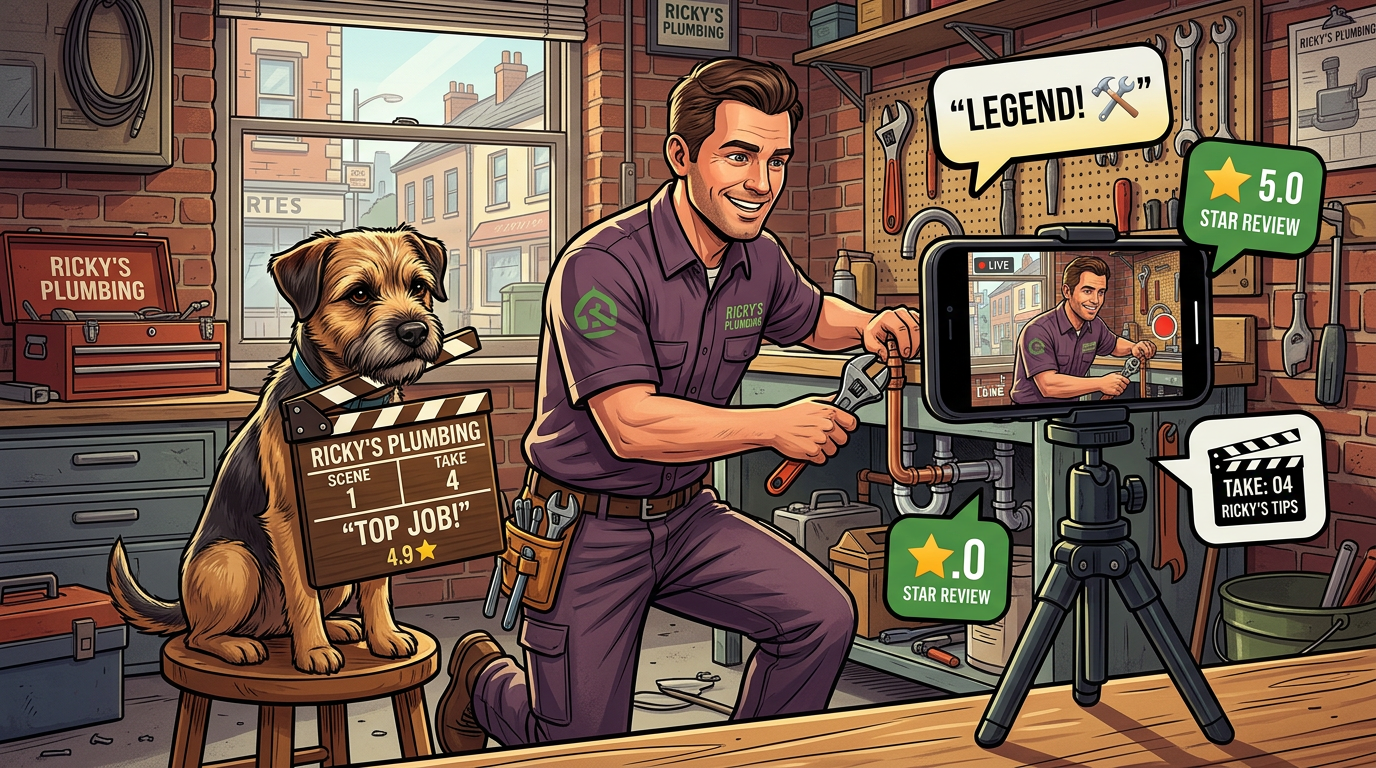
Practical creative ideas for local service businesses, plus a monthly phone-filming routine that produces plenty of fresh, genuine ads without a film crew.
Here’s a secret about ad creative for local businesses: nobody is expecting a Hollywood production. They’re hoping to spot a real person who understands their problem. A shaky-but-honest video from the owner often beats a glossy stock photo of two people laughing at a salad.
Let’s look at what works, why, and how to produce it without a film crew or a vast budget.
Why creative matters more than ever
Meta’s system now does most of the audience-finding itself, and your creative is a big part of how it decides who sees what. An ad that speaks directly to a specific problem tends to reach people with that problem. A generic ad reaches… the general public, who mostly wanted to look at holiday photos.
Ideas that tend to work for service businesses
1. The “meet the person” video
The owner or a team member talks to camera for 20 to 40 seconds: who they are, what they do, who it’s for, and what to do next. It builds trust before anyone’s picked up the phone.
2. The customer story
A short testimonial, ideally on video, with permission, covering what the problem was, what changed, and how it felt. Real words from real customers are more persuasive than anything you can write yourself.
3. Answer the question everybody asks
“How much does it cost?” “What happens at the first appointment?” “Do I need to be there?” Answering openly is refreshing, and it filters out people who aren’t a fit.
4. Behind the scenes and process
Show how the work gets done: the surveying, the preparation, the care. People hire those they trust to be careful.
5. The “moment of need” ad
Speak to the situation that triggers a search: “Boiler packed up at 6pm in January?” It meets people exactly when they need help. (Take care with wording in sensitive sectors, since ads shouldn’t suggest you know personal circumstances.)
6. Proof stack
Reviews, ratings, accreditations, years in business and before-and-after examples, presented simply, and only where policy allows and you can substantiate them.
Variation vs genuinely different ideas
This is where many people stumble.
Imagine you film one video of the owner introducing the business. You then make five versions with different headlines, a different thumbnail and a different caption. That’s one idea, five costumes.
Meta’s system tends to treat very similar ads as basically the same thing, so you don’t get five tests. You get one test and a lot of effort.
A genuinely different idea changes the angle, not just the packaging:
- Different customer worry (price vs trust vs speed)
- Different format (talking head vs customer story vs process footage)
- Different person speaking
- Different structure and opening
A useful way to think about it: Variations tweak. Concepts change the conversation.
Building concepts from motivators and barriers
Here’s a simple method:
- List why people buy from you (motivators): speed, results, peace of mind, local reputation.
- List what holds them back (barriers): cost, trust, hassle, fear of being pressured.
- Pair them up. Each pairing is a potential ad.
Example (a cleaning business):
- Motivator: getting the deposit back. Barrier: worried the landlord will still find fault. Ad: a short video walking through the checklist the cleaners use, ending with the guarantee.
- Motivator: more free time. Barrier: not trusting strangers in their home. Ad: a team member introducing themselves, plus a customer saying how it went.
Two lists and ten minutes can give you a month’s worth of ideas.
How many ads do you need?
On a small budget, four to eight genuinely different concepts a month is a healthy aim, scaling with spend. It’s not about matching the dozens a big ecommerce brand might run. It’s about keeping your ads fresh before your local audience tires of them.
The monthly phone-filming routine
You don’t need a studio. You need a plan and a couple of hours.
Week before: plan (30 minutes)
- Choose 6 to 8 concepts from your motivators and barriers list.
- Write a one-line summary and a few bullet points for each. Bullet points, not scripts: you’ll sound more natural.
Filming session (2 to 3 hours)
- Use your phone, held vertically. Clean the lens (you’d be amazed).
- Find good natural light: near a window, or outdoors on a bright but not harsh day.
- Check sound. Quiet room, phone near the speaker, no wind. Sound matters more than picture.
- Film each concept two or three times, in short chunks. The first take is rarely the best, and by the third you’ve relaxed.
- Capture extra “B-roll”: hands working, the premises, tools, results, smiling people (real ones), and anything else you can use as cutaways.
- Ask customers for testimonials on the spot, with consent, and keep a record.
Edit and prepare (1 to 2 hours)
- Use a simple editing app. Trim dead air, add captions (many people watch with sound off), and make the first three seconds count.
- Export vertical 9:16 for Reels and Stories, and consider a 4:5 or square version for feeds.
- Add a clear end line: the offer and next step.
Launch and learn
- Upload your ads, name them clearly (concept, speaker, format) so you can see what worked.
- Review after a couple of weeks. Which concepts and angles drew good leads? Do more of those.
Using Meta’s AI creative tools
Meta offers tools that can generate variations, adjust images and suggest text. They can save time, but treat them like a keen intern: helpful, but check their work. Make sure any changes still represent your business accurately, don’t alter real people in misleading ways, and still sound like you. Switch off any enhancement that doesn’t.
Signs an ad is getting tired
- The same people are seeing it again and again (rising frequency)
- Click-through rate drops
- Cost per lead creeps up while nothing else changed
- Comments turn from “interested” to “I’ve seen this a hundred times”
When you see these, rotate in the next concept you’ve already filmed.
A few honesty rules
Use real customers and real results. Get permission for testimonials and images. Don’t overstate outcomes, and follow advertising rules for your sector (in the UK, that includes the ASA’s CAP Code) and Meta’s own policies.
Want help with creative?
Coming up with strong concepts, then turning them into ads people actually stop for, is one of our favourite parts of the job. If you’d like a hand, get in touch: [link to contact page].
Next up: “My Leads Are Rubbish”.
Last reviewed: 26 October 2026