Leads, Messages, Calls or Awareness? How to Choose the Right Meta Ads Campaign Type
Not sure whether to run lead, message, call or awareness campaigns? This decision guide helps local businesses pick the right option, with a simple flowchart and comparison table.
Opening Ads Manager and seeing a list of campaign objectives can feel like walking into a hardware shop for “a thing to fix the thing.” Awareness? Traffic? Engagement? Leads? Sales? Why are there so many?
The good news: for a local service business, there are really only a few sensible choices. This guide helps you pick.
Start with the question that matters
What do you want someone to do?
- Fill in an enquiry form?
- Start a conversation?
- Phone you?
- Book online?
- Simply know you exist?
Your answer points to your campaign type.
The options at a glance
| Goal | Typical campaign | Best for | Watch out for |
|---|---|---|---|
| Get enquiries | Leads (instant form or website form) | Quotes, consultations, bookings | Low-intent forms can create poor leads |
| Start conversations | Messaging (Messenger, Instagram, WhatsApp) | Businesses where customers like to ask first | Needs fast, human replies |
| Get phone calls | Call ads | Urgent or high-value services | Needs someone to answer, and call tracking |
| Get bookings or sales online | Sales (website conversions) | Online booking, shops | Needs solid tracking |
| Be known locally | Awareness / Reach | New openings, events, brand building | Hard to measure, so keep expectations realistic |
| Get website visitors | Traffic | Rarely your best choice | Optimises for clicks, not customers |
(Meta occasionally renames objectives and tweaks options, so check the current menu.)
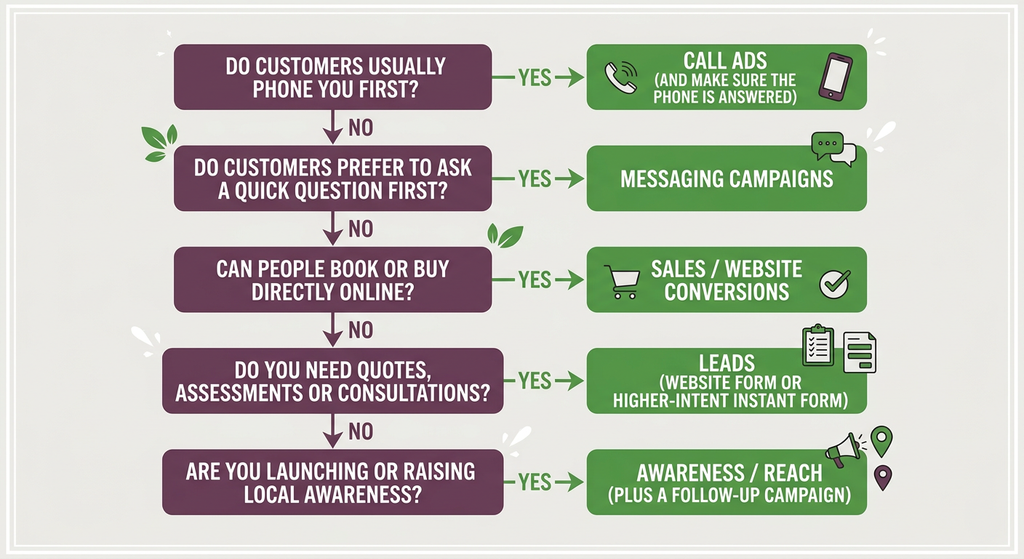
A quick flowchart
Lead methods compared
If “Leads” is your answer, there are still choices about how to collect them:
| Method | Strengths | Weaknesses |
|---|---|---|
| Instant forms (inside Meta) | Very easy for people to complete, high volume | Lower intent, more accidental or low-quality sign-ups |
| Website form or booking page | Higher intent, better tracking | Fewer leads, relies on a good page |
| Messaging | Quick, personal, easy to qualify | Needs prompt replies |
| Call ads | Very high intent | Capacity-limited, needs tracking |
A tip on instant forms: Meta typically gives you options that favour either volume or intent. A higher-intent setup (with an extra review step and a question or two) may cost more per lead but often costs less per customer. Always judge the method by customers won, not leads collected.
Matching campaign types to businesses (service businesses)
- Trades (plumber, electrician, roofer): Calls and messaging often suit urgent jobs; lead forms with a quote request suit planned work.
- Clinics and treatments (physio, dental, aesthetics): Lead forms or messaging with qualifying questions, plus attention to advertising rules on health claims.
- Salons, studios and gyms: Lead forms for introductory offers, messaging for quick questions, and booking links.
- Professional services (accountants, solicitors, coaches): Website lead forms with qualification, plus consultation booking.
- Home and garden services: Lead forms with photos or a short brief, plus a free survey offer.
Other business types, for later: retail and ecommerce lean on Sales campaigns with product catalogues; hospitality on Reach and event campaigns; B2B on qualified lead forms with longer follow-up.
Why not Traffic?
Traffic campaigns optimise for people who click. Some people click a lot and buy nothing. It’s like paying someone to hand out flyers and being thrilled with how many flyers left their hand. Unless you have a particular reason, choose an objective closer to the outcome you actually want.
Where does awareness fit?
Awareness and Reach campaigns can help when you’re opening somewhere new, running an event, or building long-term local recognition. They’re harder to measure, so be realistic. They work best alongside an enquiry-focused campaign, not instead of one.
Local settings that matter whichever you choose
- Location: set a radius or areas that match where you actually work, and consider including only people living there.
- Schedule and capacity: don’t generate calls when nobody’s there to pick up.
- Budget: one focused campaign usually beats several thin ones.
- Frequency: local audiences are small, so watch for the same people seeing your ads again and again.
Not sure which fits you?
It’s one of the first things we work through with new clients, and it’s rarely the one they assumed. If you’d like help choosing, we offer a free account review: [link to contact page].
Next up: [link to Article 7: What ads actually work for service businesses].
Last reviewed: 24 October 2026.