Struggling with Facebook or Instagram ads? The problem might not be your targeting. Learn how to build an offer people actually want to say yes to.
Here’s a scene that plays out in businesses everywhere. The ads aren’t working. The owner (or their helpful nephew, or an agency) starts changing things. The audience gets tweaked. The budget goes up, then down. The ad gets a new image. The headline is rewritten. Someone suggests turning everything off and on again, which is not strategy but is, admittedly, tempting.
Results barely move.
Why? Because very often, the thing that needs fixing isn’t in Ads Manager at all. Your offer matters.
What’s an offer, exactly?
Your offer is the deal on the table: what someone gets, what it costs, and what they have to do to get it. It’s the answer to the unspoken question every potential customer asks: “Why should I act on this, today, with you?”
“Contact us for all your plumbing needs” isn’t an offer. It’s a statement of existing.
“Boiler service, £85 fixed price, booked this week” is an offer.
Why offers matter so much now
Meta’s system is very good at finding people who might be interested in something. But it can only work with what you give it. If your offer is vague, the system finds people who are vaguely interested, which, as any shopkeeper will tell you, is a very large crowd of people who are going to do nothing.
A clear, appealing offer attracts people who are ready to act and lets the rest scroll on by. Which is exactly what you want.
What makes a good offer for a local service business?
1. A low-friction first step
Most people don’t buy a big service from a stranger on first sight. They want a small, safe way to try. Examples:
- A free, no-obligation quote or survey
- An introductory session or assessment
- A trial class
- A fixed-price starter service
The aim is to make saying “yes” feel easy and low-risk.
2. Specific and clear
Compare:
- “Affordable dental care”
- “New patient check-up and hygiene appointment, £X, includes X-rays”
The second tells you exactly what you’re getting. Specifics also build trust, because vague claims are what people expect from slightly dodgy adverts.
3. Risk reversed
People worry about wasting money, being pressured or getting poor work. Calm those worries directly:
- Clear pricing, with no hidden extras
- A genuine guarantee, if you can honour it
- Real reviews and proof
- “No obligation” language, if it’s true
4. Honest urgency
A reason to act now helps, if it’s real. “Only four slots left this month” works if you only have four slots. “Hurry, offer ends tonight!” for the fifteenth night in a row gets noticed, and not in a good way.
5. Different from the three nearest competitors
If your offer reads identically to everyone else’s, price becomes the only difference. Find something real: speed, a specialism, a particular type of customer, accreditation, a guarantee, local reputation. “We’re friendly” doesn’t count. Everyone says it, including the ones who aren’t.
A quick exercise
Grab a coffee and answer these four questions about your business:
- Who is your best customer, and what made them look for help today?
- What are they worried about? (Cost, quality, being sold to, wasting time)
- Why would they choose you over the three nearest competitors?
- What proof do you have? (Reviews, photos, years trading, awards, results)
Your answers are the raw material for a strong offer, and for ads that sound like they were written by a human who understands the customer.
Before and after (illustrative examples)
Before: “Professional cleaning services in your area. Call us today.”
After: “End-of-tenancy clean, fixed price from £X for a 2-bed flat. Deposit-back guarantee. Book a slot this week.”
Before: “Personal training for all fitness levels.”
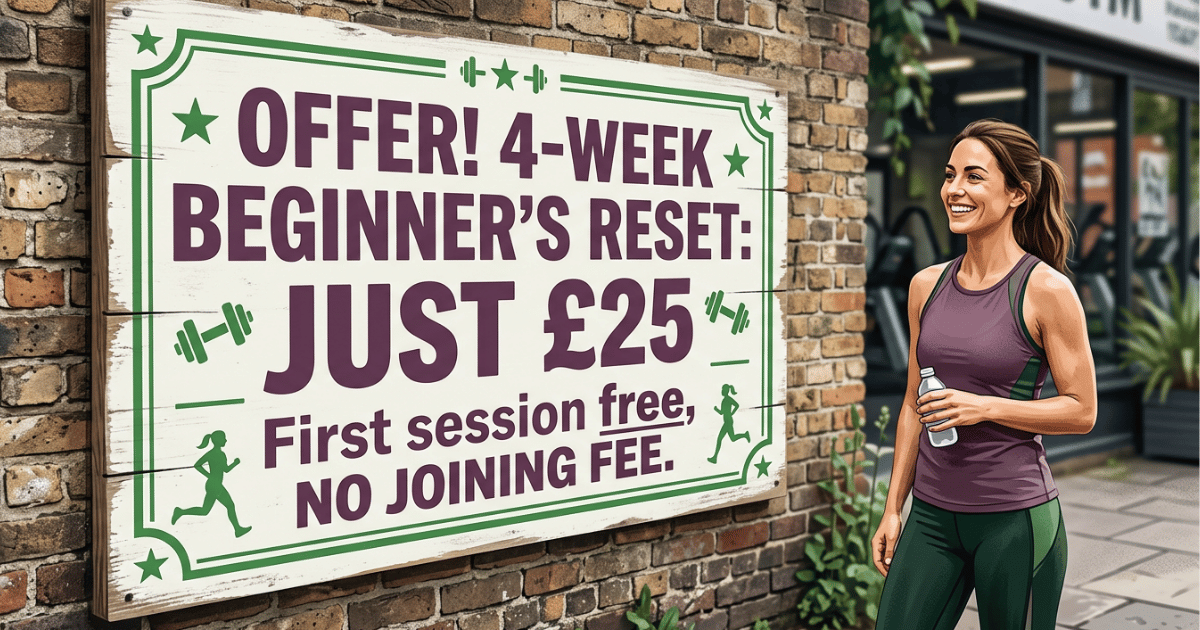
After: “4-week beginner’s reset: three small-group sessions a week, £X. First session free, no joining fee.”
Before: “Quality landscaping and garden design.”
After: “Free garden survey and fixed-price quote within 48 hours. See what’s possible before you spend a penny.”
(All examples are illustrative. Use only claims you can genuinely deliver and substantiate.)
Test the offer before you tweak the audience
If results are disappointing, resist the urge to dive into targeting settings. Instead:
- Test a different offer. Change the first step, the price framing or the guarantee.
- Then test the angle or message. Speak to a different worry or situation.
- Then test formats and details. Video vs image, different hooks.
- Only then fuss with audiences and placements.
Changing the offer usually moves results more than any other single change. It’s also something Meta’s AI can’t do for you.
Rules to keep you out of trouble
Offers need to be honest, and advertising rules apply to businesses of every size. Avoid claims you can’t prove, fake scarcity, and misleading before-and-after claims, and check the rules for your sector (in the UK, the ASA’s CAP Code is a good starting point). Meta also has its own advertising policies, particularly for sectors like health, beauty and finance.
Not sure what your offer should be?
That’s one of the most useful conversations we have with new clients. If you’d like a fresh pair of eyes on your offer and your ads, we’d love to try and help you, Get In Touch.
Next in the series: [link to Article 4: Meta Ads FAQ] or go back to Meta Ads In 2026 guide.
Last reviewed: 6 October 2026